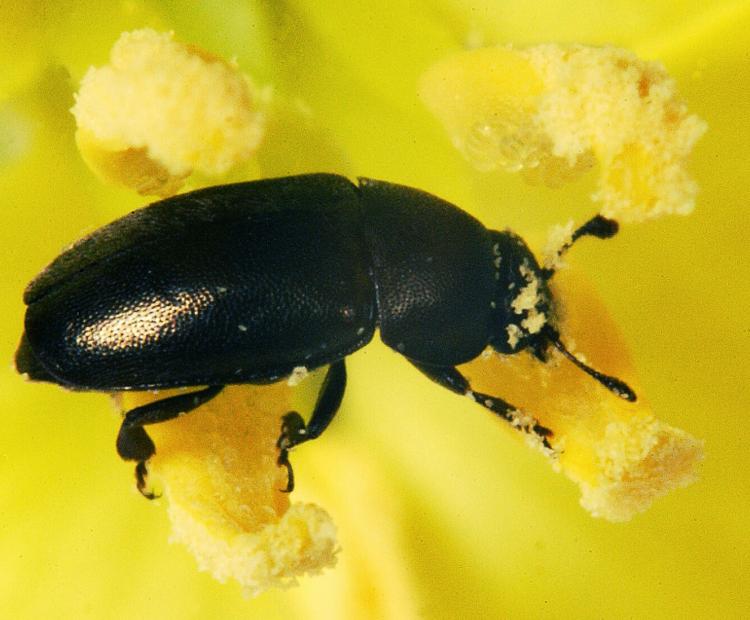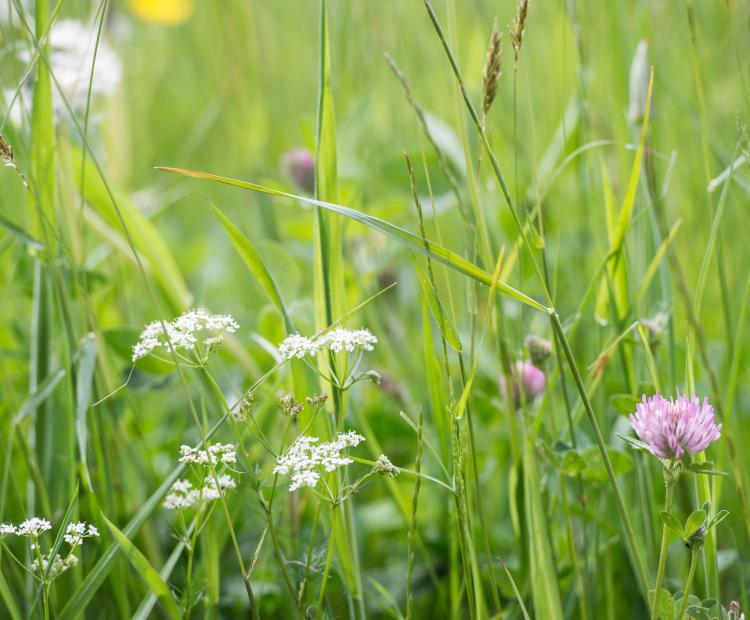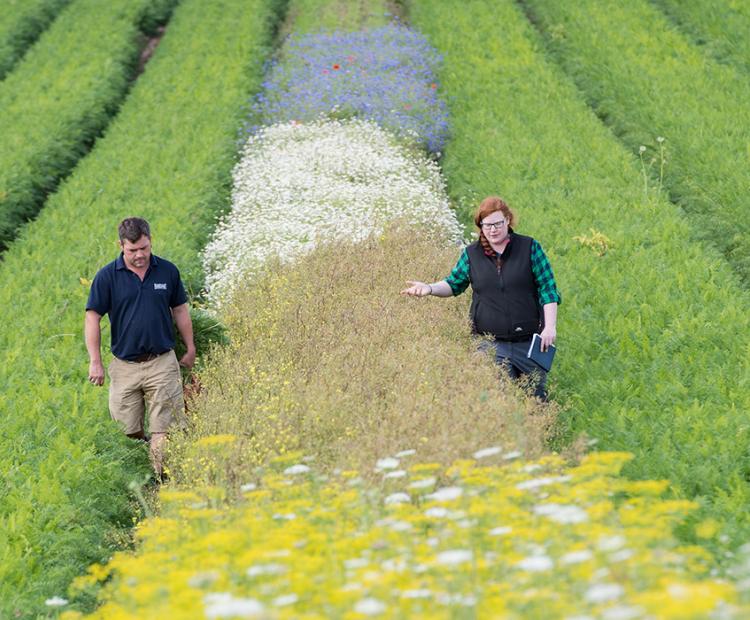
The big picture: using wildflower strips for pest control
They may be beautiful, but these strips prove pretty deadly for every farmer's mortal enemy: aphids

A suite of interactive decision-support tools from Rothamsted Research have been developed to help policymakers, catchment managers and researchers explore how nitrogen management strategies can be improved to reduce environmental impacts while supporting agricultural productivity. The tools have been developed as part of Rothamsted’s contribution to the UKRI-EPSRC funded Global Nitrogen Innovation Centre for Clean Energy and Environment (NICCEE).
Nitrogen is essential for food production, but losses from agricultural systems can contribute to a range of environmental challenges, including water pollution, greenhouse gas emissions and air quality impacts. While research continues to improve understanding of nitrogen dynamics across agricultural landscapes, there is also a growing need to make scientific knowledge accessible and actionable for those responsible for making management and policy decisions.
To address this challenge, Rothamsted researchers have developed three complementary tools designed to support evidence-based decision-making at the scale of Environment Agency Water Management Catchments across England:
Professor Adrian Collins, Science Director at Rothamsted and UK lead of the NICCEE team, said:
“Whilst we improve our understanding about the issues of nitrogen emissions from intensive agriculture through controlled and field experiments as well as computer modelling, we also need to develop informative tools to share knowledge built on research outputs to support better nitrogen management at scale. These new tools allow end-users to explore various components of N management, its unintended environmental consequences and some related interventions.”
The tools have been developed for a wide range of users, including catchment managers, environmental practitioners, national policy teams, researchers and other stakeholders involved in sustainable land management and nitrogen mitigation planning.
Identifying the largest sources of nitrogen pollution: N Emissions Apportionment App
The N Emission Apportionment App provides a quantitative assessment of nitrate emissions to water and nitrous oxide emissions to the atmosphere under business-as-usual conditions.
By attributing emissions to different nitrogen sources and land-use combinations, the tool helps users identify the dominant contributors to nitrogen pollution within a catchment.
For example, if fertiliser use on arable land is identified as a major source of emissions, management efforts can be focused on improving fertiliser practices in areas where interventions are likely to deliver the greatest environmental benefit. This targeted approach can help maximise impact while improving the cost-effectiveness of mitigation programmes.
Mapping where inhibitors work best: MAP-EI
The second tool, MAP-EI, provides spatially explicit information on the environmental factors that influence the effectiveness of nitrate and ammonia inhibitors.
Research has shown that inhibitor performance can vary considerably depending on local conditions such as soil characteristics, climate and management practices. MAP-EI combines mapped environmental datasets with current scientific understanding of inhibitor behaviour to estimate where these technologies are likely to be most effective.
The information can support decisions on where inhibitor applications may deliver the greatest environmental return, while also providing valuable data for crop production planning, nutrient management strategies and environmental assessments.
Researchers can also use the mapped datasets to scale up findings from plot-scale studies and assess the broader environmental and economic implications of inhibitor technologies across larger regions.
Exploring future fertiliser scenarios: R-FEST
The third tool, R-FEST, enables users to explore how changes in fertiliser management could influence environmental outcomes.
The interactive scenario-modelling platform allows users to evaluate alternative fertiliser products, application rates, embedded carbon emissions, adoption levels and emission factors. This helps users assess potential mitigation strategies and understand the environmental trade-offs associated with different approaches.
One application is the assessment of lower-carbon fertiliser products, including emerging green ammonia-based fertilisers. Users can compare different scenarios to evaluate potential greenhouse gas reductions across regions and farming systems, helping identify effective pathways for reducing agriculture's unintended environmental footprint.
Together, the three tools provide a complementary suite of decision-support resources.
Dr Yusheng Zhang, modeller at Rothamsted and part of the NICCEE team, said:
“Scientists are advancing our understanding of nitrogen dynamics in agricultural systems through a range of active research projects. These interactive tools help translate the latest scientific knowledge into good management solutions that can technically deliver both environmental and economic benefits. Feedback from users will also help us identify areas where our models can be improved and highlight gaps in our understanding of nitrogen flows across the air, plant, soil and river system.”

Science Director

Hydrologist
Rothamsted Research is the longest-running agricultural research institute in the world. We work from gene to field with a proud history of ground-breaking
discoveries in areas as diverse as crop management, statistical interpretation and soil health. Our founders, in 1843, were the pioneers of modern
agriculture, and we are known for our imaginative science and our collaborative approach to developing innovative farm practice.
Through independent research, we make significant contributions to improving agri-food systems in the UK and internationally, with
economic impact estimated to exceed £3 bn in annual contribution to the UK economy. Our strength lies in our systems approach, which combines strategic research,
interdisciplinary teams and multiple partnerships.
Rothamsted is home to three unique National Bioscience Research Infrastructures which are open to researchers from all over the world:
The Long-Term Experiments,
Rothamsted Insect Survey and the
North Wyke Farm Platform.
We are strategically funded by the Biotechnology and Biological Sciences Research Council (BBSRC), with additional support from other national and
international funding streams, and from industry. We are also supported by the Lawes Agricultural Trust (LAT).
The Biotechnology and Biological Sciences Research Council is part of UK Research and Innovation, a non-departmental public body funded by a grant-in-aid
from the UK government.
BBSRC invests to push back the frontiers of biology and deliver a healthy, prosperous and sustainable future. Through our investments, we build and support a vibrant,
dynamic and inclusive community which delivers ground-breaking discoveries and develops bio-based solutions that contribute to tackling global challenges,
such as sustainable food production, climate change, and healthy ageing.
As part of UK Research and Innovation (UKRI), we not only play a pivotal role in fostering connections that enable the UK’s world-class research and innovation system
to flourish – we also have a responsibility to enable the creation of a research culture that is diverse, resilient, and engaged.
BBSRC proudly forges interdisciplinary collaborations where excellent bioscience has a fundamental role. We pioneer approaches that enhance the equality, diversity,
and inclusion of talent by investing in people, infrastructure, technologies, and partnerships on a global scale.
The Lawes Agricultural Trust, established in 1889 by Sir John Bennet Lawes, supports Rothamsted Research’s national and international agricultural science through the provision of land, facilities and funding. LAT, a charitable trust, owns the estates at Harpenden and Broom's Barn, including many of the buildings used by Rothamsted Research. LAT provides an annual research grant to the Director, accommodation for nearly 200 people, and support for fellowships for young scientists from developing countries. LAT also makes capital grants to help modernise facilities at Rothamsted, or invests in new buildings.